
Louvered vs. Solid Patio Covers: Which Is Best for Phoenix?
Louvered vs solid patio covers comes down to one simple question: do you want to adjust your shade, or set it and forget it? In my 20-plus years building patio covers around Phoenix, solid insulated covers have been the best fit for most Valley homes, while louvered covers are worth the extra money if you want winter sunshine, airflow, and total control.
I own Southwest Patio, and I have helped folks make this exact call for two decades. Here is how I walk my own customers through it.
Louvered vs Solid Patio Covers: The Quick Breakdown
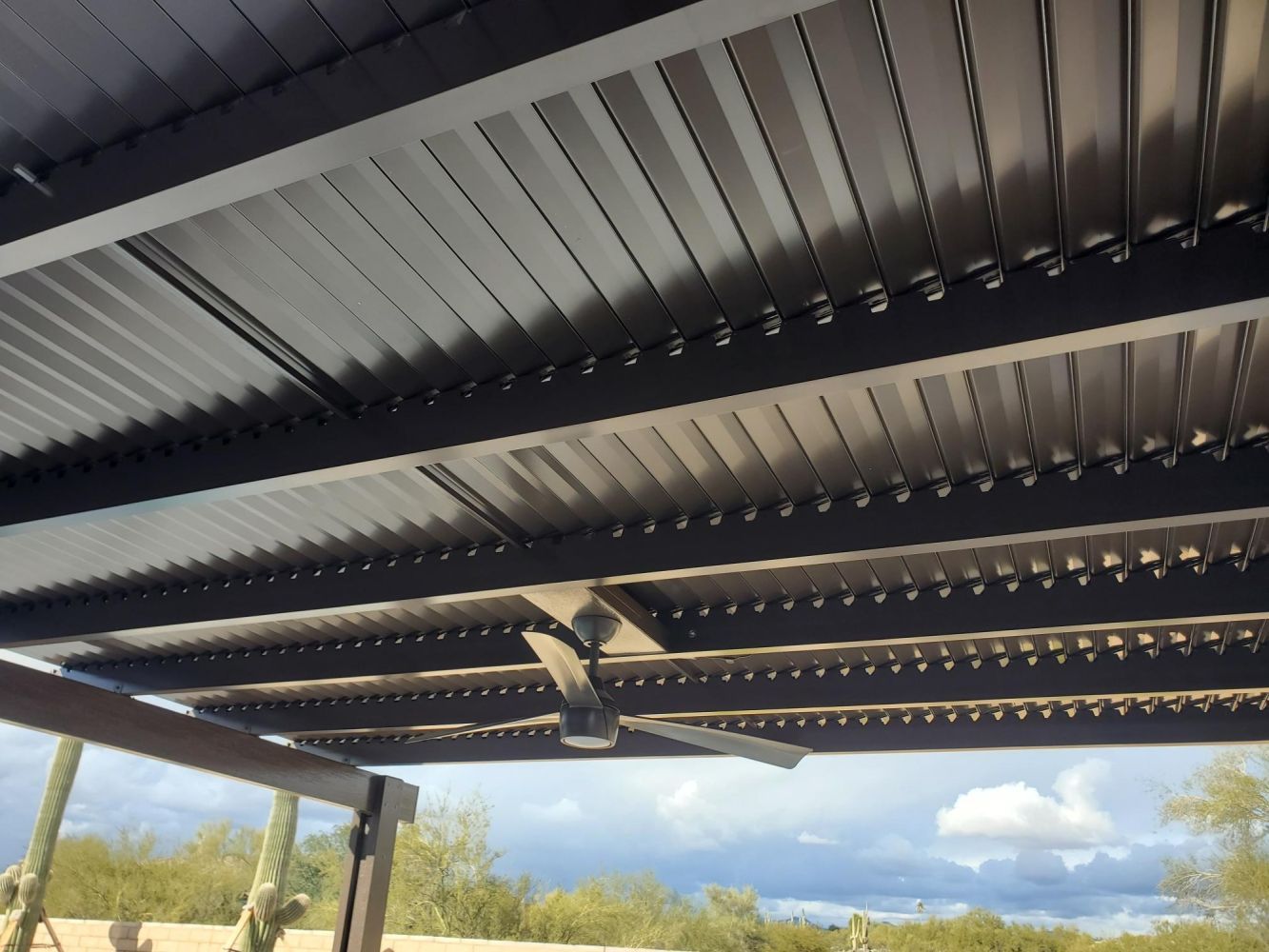
Here is the short version. A louvered cover (our adjustable style) has aluminum slats that rotate. Open them for sun, tilt them for airflow, or close them tight for full shade and rain protection. A solid cover is a fixed roof. It blocks sun and rain every day, all year, with zero effort.
A few rules of thumb I share at almost every estimate:
• Want total control and winter sun? Go louvered.
• Want the most shade for the fewest dollars? Go solid.
• Grill or entertain under the cover a lot? Louvers vent heat and smoke better.
• Planning ceiling fans and lights? Both work, but a solid cover makes the wiring easy.
Louvered vs. solid is really round two of the decision — round one is the material itself. If you're still torn between a classic wood pergola and modern wood-grain aluminum, that choice affects maintenance, termites, and how your cover handles our sun for the next decade. Start with our honest breakdown of wood vs. aluminum patio covers for Arizona homes.
If you land on a solid cover, there is one more decision to make about the panel itself. Solid covers come as ribbed W-pan or insulated flat pan, and they are not the same product. Here is the breakdown: W-pan vs flat pan patio covers.
Why Louvered Covers Shine in the Valley
Our adjustable louvered patio covers are the premium option, and there is a good reason people love them here. Phoenix is not hot all year. From November through February, that low winter sun feels wonderful on the patio. With a louvered cover, you open the slats and let it pour in. Come May, you close them and you have deep shade again.
The louvers also help with trapped heat. On a 110-degree evening, heat keeps rising off your patio slab. Crack the louvers a few inches and it escapes instead of cooking you. We install Solara adjustable covers, built for Arizona sun, with a manual crank or a remote. Push a button, change your shade. It never gets old.
If you like the idea of opening your shade to the sky, a louvered cover is one route and an awning is another. See how they stack up in our retractable awning vs patio cover comparison.
If a ceiling fan is part of your plan, that alone may settle the louvered-versus-solid question. Louvers have moving slats where a fan would hang, while a solid insulated cover can carry a fan beam and hide the wiring. Read our guide to adding a ceiling fan to a patio cover in Arizona.
When a Solid Cover Is the Smarter Buy
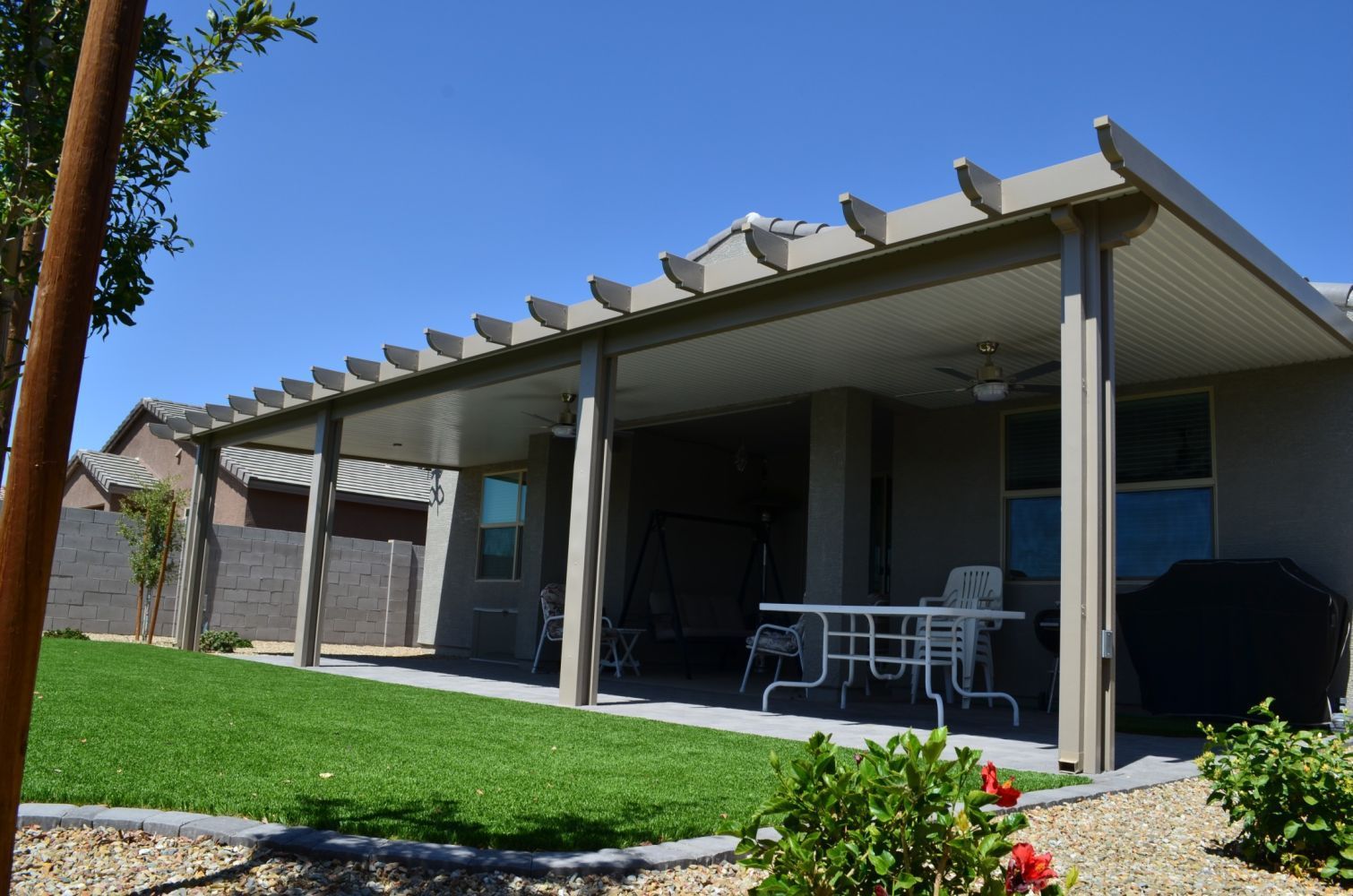
I will be straight with you: I sell more solid covers than louvered ones, and for good reason. A solid insulated patio cover gives you cool, dependable shade every single day with no moving parts. The panels have a foam core sandwiched between two sheets of aluminum, so the roof itself blocks heat from radiating down on you. That matters a lot on a west-facing patio that takes the brutal afternoon sun.
If the budget is tighter, a solid flat pan patio cover still delivers honest shade for less money. And with Elitewood trim, a solid cover can look like it was built with the house. For most west-facing patios in Surprise, Goodyear, or Buckeye, all-day shade beats adjustability.
A Tale of Two Patios on the Same Street
Last spring we did two jobs on the same street in Goodyear. The first house had an east-facing patio. The owners loved morning coffee outside, but their old solid cover made the patio dark and chilly from Thanksgiving to March. We replaced it with a louvered cover. Now they open the slats on winter mornings and close things down by summer lunchtime. They say it feels like a whole new room.
Three doors down, the neighbors had a bare west-facing patio you could not touch after 2 p.m. all summer. They wanted shade, period, with no fiddling. We built an insulated solid cover with two ceiling fans, and now it is the coolest spot in the yard. Same street, opposite answers. That is why I never quote a cover without standing on the patio first.
One more thing to weigh when you're picking a style: wind. Monsoon season is hard on patio covers, and louvered and solid covers handle storms a little differently — louvers can open up and let a gust pass through, while a well-anchored solid cover rides out driving wind and rain as one piece. I wrote up what I've seen in 20-plus years of Valley storms, including what fails first and why, in can a patio cover withstand Arizona monsoon winds.
The Honest Downsides of Each
No product is perfect, so here is the other side. Louvered covers cost quite a bit more, often close to double a comparable solid cover, and moving parts mean a little more upkeep. Monsoon dust storms leave grit on the louvers, so plan on rinsing them a couple of times a year. And while closed louvers shed rain well, they are not a sealed roof, so a hard sideways monsoon blast can push a few drips through. If numbers help you decide, my post on aluminum patio cover costs in Arizona breaks down real prices.
Solid covers have a trade-off too. The shade you love in July is the same shade you get in January, and the rooms behind a solid cover can feel a touch darker in winter. If your patio faces north or east, think hard before giving up that gentle morning sun year-round.
Exposure changes the answer. On a west-facing patio the low afternoon sun comes in sideways, and the roof is only half the solution. See how we handle that in the best patio cover for a west-facing yard in Arizona.
Call The Shade Experts at 623-695-6445 for a Free Estimate
If you are still weighing louvered vs solid patio covers, the fastest way to decide is to have us stand on your patio and look at sun, exposure, and budget with you. Southwest Patio has been shading Arizona homes for more than 20 years. We are licensed, bonded, and insured (ROC #282768), we handle the HOA paperwork and city permits, and financing is available.
Estimates are always free, and I promise you a straight answer, even if that answer is the cheaper cover. Call or text 623-695-6445 and let's figure out which cover fits your backyard.
FAQ: Louvered and Solid Patio Covers in Phoenix
Do louvered patio covers leak when it rains?
Closed louvers overlap and drain into a built-in gutter, so normal rain is no problem. A hard sideways monsoon storm can push a few drips through. If you need a bone-dry patio every time, go solid insulated.
Which cover is better for a west-facing patio?
Usually a solid insulated cover. West-facing patios take the worst heat of the day, and the foam core keeps it from radiating through the roof. A louvered cover works too, but you would keep it closed most of the summer anyway.
Do I need HOA approval or a permit for either style?
In most Valley neighborhoods, yes to the HOA and often yes to a city permit, for both styles. Do not let that scare you off. We prepare the HOA paperwork and handle the permit process, so all you really do is sign.